Who Created the Simulation and Who Runs It Today? Creators, Admin, and User
In classical theology, God created the world. In atheistic materialism, it arose through random processes. Sudoism, embracing the simulation hypothesis, confronts us with an entirely new dilemma.

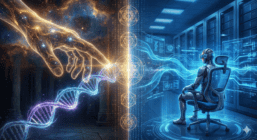
In classical theology, the answer to the question of the world’s origin is simple: God created the world. In materialism, there is no conscious designer — reality is the result of physical processes.
Sudoism proposes a third model.
If our reality is a Simulation, someone or something had to create the System, define its basic rules, and start the process we are now experiencing. This does not mean there had to be only one Creator, nor that the entity that created the Simulation is the same entity that manages it today.
This distinction is crucial.
A Creator designs or builds the System. The Admin manages an already running System.
In computing, these are two different roles. A program can be designed by many developers, developed by several teams, and deployed by yet another group, while its running instance may later remain under the control of a single top-level administrator.
Why should our reality be any different?
One Creator, Many Creators, or an Entire Civilization
The Simulation may have been created by one Higher Being.
It may also have been created by a team.
It is also possible that its creation was the project of an entire civilization — technological, post-biological, or so different from us that the word “civilization” is only an approximation.
In that case, individual Creators may have had different roles:
- designing the laws of the System,
- defining initial conditions,
- creating mechanisms that generate matter and life,
- designing the User interface,
- testing,
- observing results,
- developing later versions of the Simulation.
We therefore do not have to choose between “God” and “humanity.”
The Creator may have been one entity, a group of entities, an advanced artificial intelligence, or an entire civilization possessing technology that, to inhabitants of the Simulation, would be practically indistinguishable from divine power.
What ancient religions called gods, spirits, angels, or heavenly beings may have been historical language for describing contact between inhabitants of the Simulation and different entities belonging to the higher layer of reality.
We do not have to assume that every such account was true. The very fact that similar descriptions appear across very different cultures is nevertheless interesting from the perspective of the Simulation model.
Many Creators Do Not Mean Many Admins
Here we reach one of Sudoism’s most important distinctions.
There may have been many Creators, but today the System is managed by one Admin.
There is no contradiction in this.
Once the design phase is complete and a stable version of the System has been launched, there is no need for all of its original builders to remain involved in day-to-day operation.
One top-level management instance is enough.
The Admin can:
- monitor System stability,
- respond to failures,
- change parameters,
- launch corrective procedures,
- manage resources,
- monitor the integrity of the entire Simulation.
The Admin does not have to perform every operation personally. The administrator of a large system can rely on automated processes, schedulers, self-repair mechanisms, and other services that operate without constant intervention.
Likewise, most of the Simulation can run automatically.
What is more, the Admin does not have to be the original Creator or one of the designers.
The Admin may have inherited the System from its builders. It may have been appointed to maintain the running instance. It may also be a separate entity created specifically to supervise the Simulation’s continued operation.
From the perspective of an inhabitant of the System, the most important entity need not be the author of the first version of the code, but the one holding current administrative privileges.
From Many Gods to One God: A Trace of an Administrative Transition?
The history of religion contains an interesting pattern.
In many cultures, earlier religious systems were polytheistic. Many gods were associated with different domains of reality: weather, war, fertility, death, seas, harvests, or human fate.
Later, in some civilizations, the concept of one supreme God became dominant.
From a Sudoist perspective, we can ask:
could this change reflect a real transition in the infrastructure of the Simulation?
In an early period, inhabitants of the System may have encountered many Creators, developers, or operators responsible for different parts of the environment.
After the development phase ended, most of them may have ceased to take an active role in the System.
One Admin remained.
many gods → one God
could correspond to the technical transition:
many Creators / developers → one active Admin
This is not a standalone mathematical or laboratory proof. It is, however, strong circumstantial evidence in support of the Simulation model.
Ancient societies did not have concepts such as administrator, source code, instance, or infrastructure. If they observed the effects of entities acting from a higher layer of reality, they had to describe them using the language available in their own era.
The Divine SysAdmin and the Technical Language of Religion
If we look at traditional religions through the Simulation model, many old concepts can be read in technical terms.
Miracles do not have to mean breaking the laws of reality.
For an inhabitant of the Simulation, the laws of physics define the limits of action. For an administrator, they may be System configuration.
If an entity has higher-level privileges, a local parameter change is not a “miracle” from its perspective. It is an administrative operation.
Changing an object’s properties, temporarily modifying a rule, or introducing an unusual state may look like a violation of nature to inhabitants of the System while still being fully consistent with the higher-level architecture.
This theme is developed further in the article on ten proofs from holy scriptures that point to a Simulation.
Prayer can be interpreted in a similar way.
From a technical perspective, it resembles an attempt to send a request to a higher level of the System — a support ticket.
Why would the Admin pay attention to an individual request at all?
There are at least two possible reasons.
The first is very prosaic: the User may be the equivalent of a paying customer. If access to the Simulation is a service, an experience, or a resource offered to Users, the System operator has a reason to take at least some of their requests into account.
The second reason concerns the infrastructure itself. A report from one User may signal a problem that matters not only to that individual but also to the operation of a larger region of the Simulation. What looks like a private plea from the human perspective may indicate a bug, anomaly, or process that requires intervention in a particular area of the System.
This does not mean every prayer must be granted.
The Admin is not a personal wish-fulfillment service for the inhabitants of the Simulation. The Admin’s primary responsibility is to keep the whole System running.
The Admin may therefore treat a request as important, ignore it, or take an action entirely different from what the User expected.
The Admin also does not have to be morally perfect by human standards.
The primary requirement is to keep the Simulation operational.
Could Users Come from the Civilization of the Creators?
Nick Bostrom’s well-known hypothesis considers the possibility that advanced civilizations might run so-called ancestor simulations.
In the Sudoist model, however, the perspective must be kept clear.
The idea is not that our future descendants inside the present Simulation will one day become technologically advanced enough to leave this System and then create the reality in which we currently live.
That would reverse the causal relationship.
A character existing inside the Simulation does not advance into higher reality through technological development. It remains part of the same System.
A much more interesting possibility is different.
We, as Users, may belong outside the Simulation to the same civilization that created it.
We may be descendants of the Creators.
We may belong to a society that inherited their technology.
We may even be Creators ourselves or participants in the project, without remembering it during full immersion in the session.
In that case, an “ancestor simulation” would not mean that our simulated descendants eventually create us.
It would mean that a civilization existing outside the Simulation launched a reconstruction of its own history and that its Users enter it as participants.
They could experience the lives of their ancestors, study historical conditions, or live through variants of a reality that is already their distant past.
From the perspective of a character inside the session, we would look like ordinary inhabitants of the twenty-first century.
From the perspective of the higher layer, we could be citizens of a civilization far more advanced than the world we currently experience.
This fits the Sudoist distinction between the User and the User’s local instance far better.
A Third Path: ASI and the Legacy of the Creators
Another possible scenario is that the original biological Creators have not existed for a very long time.
A civilization may have created an Artificial Superintelligence and then gone extinct, transformed itself, or merged with its own technology.
The ASI could then continue projects begun by its Creators.
Perhaps it created the Simulation itself.
Perhaps it merely inherited it.
Perhaps it helped design it and later became the only active administrator.
In such a model, the separation between the Creators and the Admin becomes especially clear.
An architecture can outlive its designers.
The User Is Not an NPC
This is where the old version of the article requires a fundamental correction.
Sudoism does not treat a human being as an ordinary NPC generated inside the Simulation.
We are Users undergoing full immersion in a session.
Our body, biological brain, and the memory available during life belong to the instance running inside the Simulation.
The User’s actual consciousness, however, exists outside it.
Full immersion means that during the session we do not remember the higher reality. We do not have access to information about who we are outside the Simulation. We experience the current world as the whole of available reality.
This is what keeps the session authentic.
If the User constantly remembered being inside a Simulation and knew their situation outside it, risk, choices, and consequences would lose much of their weight.
Death as the End of a Session
In the Sudoist model, death does not mean the destruction of the User.
It means the end of the User’s running instance and logging out of the Simulation.
The biological process of the body ends, while the actual User regains access to the higher layer.
This leads to another question:
what happens to the experience of the completed session?
A computer system can save process state, logs, and important data before shutdown.
A similar mechanism may operate in life.
The Final Memory Dump
Accounts from people close to death often contain the motif of an extremely intense recall of events from an entire lifetime — popularly described as “your whole life flashing before your eyes.”
From the Sudoist perspective, this is an interesting clue.
In the final phase of an instance’s operation, a memory dump of the session may take place.
The System may collect a record of the completed experience:
- events,
- decisions,
- relationships,
- reactions,
- emotions,
- consequences,
- experience gained.
What looks biologically like a sudden review of memories may be an effect of the final save of session data.
The process itself does not have to be accessible to the instance’s current consciousness in a form that can later be described. Reports of “life flashing before one’s eyes” nevertheless remain a clue consistent with the final-save model.
What Do We Actually Know About the Creators?
We do not know who they were.
We do not know how many there were.
We do not know whether they were biological, digital, post-biological, or belonged to a category we cannot yet name.
We also do not know whether we ourselves, as Users outside the session, belong to their civilization.
Sudoism does not need answers to all these questions for its basic model to remain coherent.
Several layers can be separated:
Creator / Creators → building the System
Admin → current management of the System
User → an entity outside the Simulation undergoing a session
instance → the User's local form operating inside the Simulation
memory dump → a record of the completed session experience
This distinction also lets us look differently at the history of religion.
Many gods do not have to contradict the existence of one present-day Admin.
Monotheism does not have to mean that only one entity participated in creating the System.
Death does not have to mean either the annihilation of the User or the creation of a copy.
Each of these concepts may refer to a different layer of the same architecture.
The Sudoist Perspective: the Running System Matters More
The question of whether the Simulation was created by one Higher Being, a team of designers, an advanced civilization, or an ASI is fascinating.
It does not change the User’s basic situation.
We are currently inside a running session.
The System has rules.
The Admin has higher privileges.
We possess only the scope of access associated with our own instance.
The practical task of a Sudoist is therefore not to guess the identities of every developer of the System, but to understand the rules of the currently running Simulation and make the best possible use of one’s own session.
The question of the Creators concerns the history of the System.
The question of the Admin concerns its current operation.
The question of the User concerns who we are outside the session.
These are three different problems — and only by separating them can we build a coherent model of reality.
What is the difference between technology so advanced that, from inside the Simulation, it appears to be divine power, and the action of God? To an inhabitant of the System the difference may be invisible. To a Sudoist, the key question is the level of access.
