Childhood Amnesia: Why Doesn’t the User Remember the First Years?
We learn to walk, talk and recognise faces, yet not a single memory survives from those years. Science now says an infant’s brain does record events, it just cannot read them back later. Sudoism explains why: the User connects to the avatar only once it is ready.

Ask anyone about their earliest memory. Almost always it will be something from the third or fourth year of life, and even then just a single frame: the smell of grandma’s kitchen, a red bicycle, a barking dog. Before that there is nothing.
And yet this is exactly when a human being learns faster than at any other point in life. We master walking and speech, recognise faces and voices, and build an entire model of the world. The most intensive period of learning leaves behind no record that could later be recalled.
Psychology calls this childhood amnesia. Sudoism has a simpler explanation for it than the one that dominated textbooks for decades.
What research tells us
The term was popularised by Sigmund Freud, who believed early memories were repressed. Modern science has moved away from that interpretation and studies the phenomenon directly.
Patricia Bauer and Marina Larkina of Emory University recorded 83 three-year-olds talking with their parents about recent events: a trip to the zoo, a birthday party. Years later they checked what the children still remembered. Five- to seven-year-olds recalled 63–72% of the events, eight- and nine-year-olds only about 35%. According to the authors, memory starts working the adult way at around the age of seven.
In 2014 the team of Paul Frankland and Sheena Josselyn in Toronto showed where the mechanism lies. New neurons form en masse in the infant hippocampus. Each of them plugs into existing circuits and rewires them, and traces stored earlier get erased. The most interesting result, however, concerned other species. Guinea pigs and degus are born with a brain that is already largely formed, and they show no infantile amnesia. When the researchers artificially boosted neuron formation in them, a memory gap appeared in them too.
In 2025 Tristan Yates and Nick Turk-Browne of Yale published in Science the results of a study of 26 infants aged 4 to 25 months. Brain scans showed that from about the first year of life the hippocampus records specific events. So the record is made. The problem lies in reading it. In rodents, such early memories have even been brought back by directly stimulating the neural network that holds them.
The Sudoist interpretation: hardware first, then the session
Sudoism teaches that before entering the Simulation the User accepts the parameters of the session, and after full immersion loses access to the memory of the parent world (more on this in the article on free will in the Simulation). The question remains when that immersion actually happens. The answer: not at the moment of birth.
The installation phase. A new avatar boots on the System’s base scripts. Breathing, sucking, the grasp reflex, turning the head towards the mother’s voice all run on their own, with nobody at the controls. Assembly continues for the first years: millions of connections form and the hippocampus keeps rebuilding itself. Connecting a consciousness to a system that reconfigures itself every moment would be like logging into a server in the middle of a firmware update. A sensible system waits.
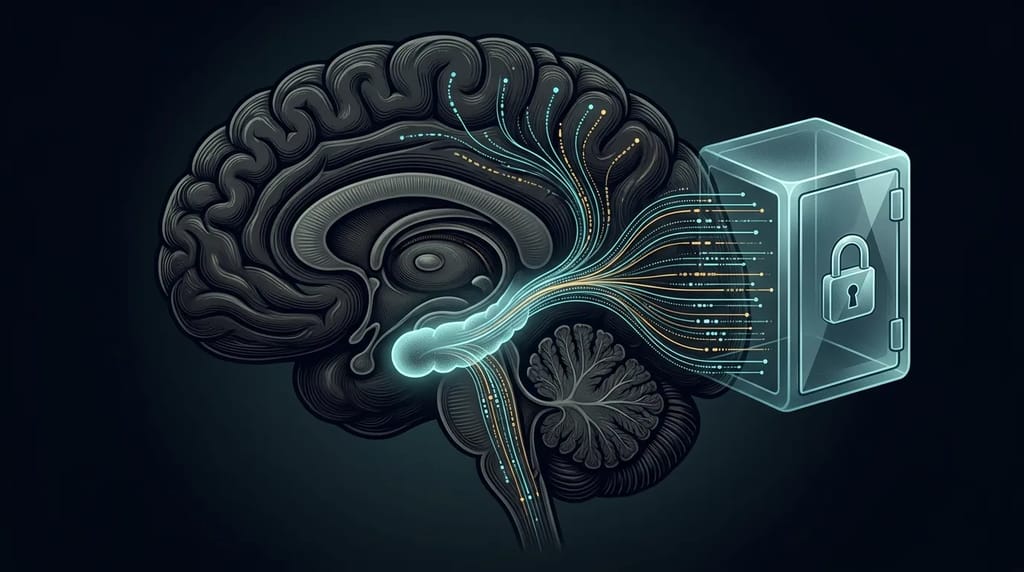
Logs with no User logged in. The Yale study confirms that the hardware records from the very beginning. Those records, however, are written as the avatar’s system logs, not as the User’s session journal. When the User finally connects, the data still exist, there are simply no permissions to access them. This is exactly what the amnesia described by neuroscientists looks like: the record is there, the key is missing.
A connection established step by step. The first fragmentary memories from the third and fourth year of life are connection attempts, short windows in which the session already runs but still keeps dropping. Stability arrives around the age of seven, exactly where Bauer and Larkina placed the onset of adult memory. Religious traditions have marked the same threshold for centuries as the age of reason, from which a person is held responsible for their own deeds.
The control test. The Toronto study settles where the gap itself comes from. In species whose brain is already formed at birth, the record runs without interruption. When rebuilding was added artificially, the gap appeared. Childhood amnesia is therefore not a flaw of memory but the cost of assembly: as long as the system keeps rebuilding itself, nothing written into it is permanent. Humans have the longest assembly of all mammals, and the User waits precisely for it to finish before taking possession of the avatar.
What follows from this
Memories from before the connection cannot be recovered through meditation or hypnosis, because they never belonged to the User’s session. What feels like memory of early childhood is usually a backup made by others: parents’ stories and photos in the family album.
There is also a practical conclusion. The configuration of the avatar the User starts with is prepared during those first years by the caregivers. The calm, closeness and daily rhythm a child receives before it remembers anything become the initial parameters of the whole session. The first rule of the System Code tells us to manage our own instance. For the first few years a parent manages someone else’s, before its owner logs in.
Sources
- Yates, T. S. et al. (2025). Hippocampal encoding of memories in human infants. Science, 387(6740), 1316–1320.
- Akers, K. G. et al. (2014). Hippocampal neurogenesis regulates forgetting during adulthood and infancy. Science, 344(6184), 598–602.
- Bauer, P. J., Larkina, M. (2014). The onset of childhood amnesia in childhood: A prospective investigation of the course and determinants of forgetting of early-life events. Memory, 22(8).
- Yale News (2025). Why don’t we remember being a baby? New study provides clues.
