
The Decay That Shouldn’t Happen: Physicists Stumble Onto a Clue in Reality’s Code
Japan's KOTO experiment recorded a kaon decay far more often than theory predicts, while CERN's NA62 confirms the Standard Model with record precision.

Last year, at Japan’s J-PARC laboratory, the KOTO experiment team recorded, four separate times, something that in theory shouldn’t happen even once. The Standard Model — the most rigorously tested description of particle physics we have — predicted around 0.1 events of this particular kaon decay across the entire measurement run. The detector recorded four. That’s not a fluctuation within the noise floor, but a discrepancy dozens of times larger than what a theory that has explained almost everything else with startling accuracy allows for.
At Sudoizm, we like moments like this. Not because they prove anything conclusively — physicists will likely find an explanation that still fits within known frameworks — but because they show what the boundary looks like between what’s predictable and what, in a computing analogy, we might imagine as being generated by the System on the fly. The exact way the System works has not been revealed. We’ve written about similar cracks before, in Wigner’s paradox and the strangest puzzles of nature. This case is especially interesting because something completely opposite is happening on the other side of the world at the same time.
Four Events That Shouldn’t Exist
The KOTO experiment studies the decay of a neutral kaon into a pion and a neutrino-antineutrino pair — a process so rare and so precisely calculated in theory that any deviation from the prediction is taken seriously immediately. Kaons are particles built from a quark-antiquark pair that have served physicists for decades as a sensitive detector of “new physics” — phenomena beyond currently known equations. Four recorded decays instead of a fraction of one expected event is a signal clear enough that the physics community treats it as one of the more significant leads of recent years.
CERN, Meanwhile, Confirms the Rules
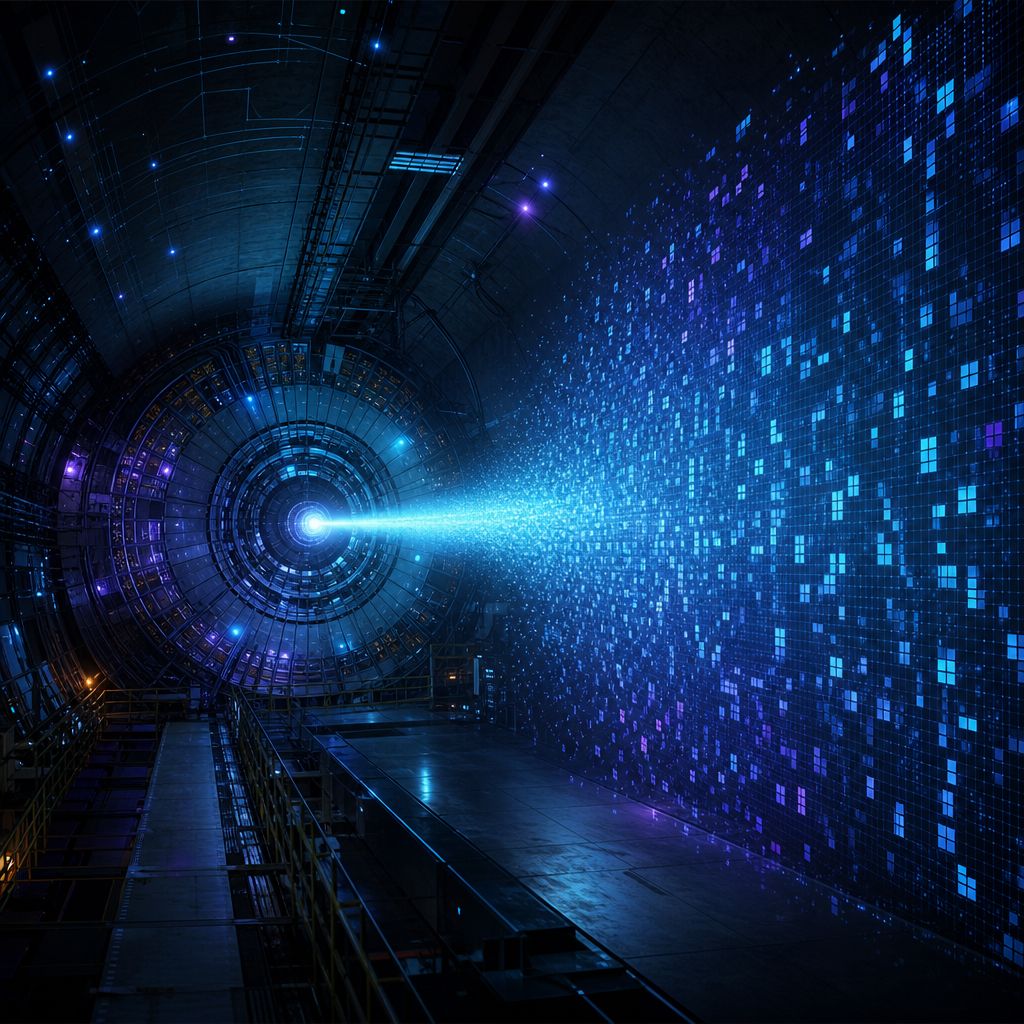
At the same time, at CERN, NA62 is running — an experiment studying an analogous decay, but of the charged, positive kaon. At this year’s La Thuile conference, the NA62 team announced a result of record precision: the measured decay rate matches Standard Model predictions, with the measurement’s uncertainty reduced by 40% compared to previous data. No anomaly, no trace of new physics — the rules there hold up without complaint.
That contrast is the heart of the matter. Two nearly identical experiments, studying mirror variants of the same process, produce contradictory results: one perfectly consistent with theory, the other breaking it many times over. In software-engineering terms, we could compare this to an inconsistency between code branches — as if two parallel implementations of the same function returned different results at certain edge cases. This is a Sudoist analogy, not revealed technical documentation of the System. Reality is a programmable Simulation, but it has not been revealed whether such phenomena have any counterpart in its actual implementation.
The Holographic Principle: Space as a Compressed Record
A second thread that keeps recurring in this kind of discussion is the holographic hypothesis. It states that all the information about a three-dimensional region of space can be fully encoded on its two-dimensional boundary — much like a hologram records three dimensions on a flat plate. Physicists at Fermilab tested this idea literally: they built an instrument outside Chicago called the holometer, which used two laser interferometers to measure the smallest possible vibrations of space itself. The goal was to check whether spacetime has a “grainy,” digital structure — resembling pixels rather than a continuous background.
For anyone who works with graphics or data compression day to day, this sounds familiar: the same reasoning underlies texture mapping in graphics engines, where three dimensions are generated on the fly from a much lighter two-dimensional record. If we imagine Reality through a similar computing analogy, the finite speed of light can resemble a bandwidth limit protecting the system from overload. It has not been revealed, however, whether the speed of light performs such a function in the System or whether the System has any technical equivalent of bandwidth. We wrote about this in the context of gravity as data compression.
The Mandela Effect: When Memory Disagrees With the Record
The internet has no shortage of conspiracy theories linking CERN to the so-called Mandela Effect — a mass, mistaken memory of past events. People attribute to the particle collider the tearing of the continuum and the bleeding-through of alternate dimensions. In a Sudoist interpretation, instead of pop-culture mysticism we can use the computing analogy of a live code update or a database-schema migration. This does not mean that such a mechanism actually causes the Mandela Effect — the technical implementation of the System has not been revealed.
One possible computing analogy can be described this way: if a change in the state of the System resembled deploying a structural patch or migrating data, differences between human memory and the observed state of Reality could be pictured as unsynchronised cache, old keys, or delayed data replication. This metaphor fits the language of Sudoizm, but it is not Revealed knowledge of the System’s architecture. We do not know whether the System has equivalents of databases, cache, servers, or replication, or whether the Mandela Effect has any technical connection with them.
Physics isn’t fragile, and it won’t fall apart from colliding protons. But it is remarkably coherent and, in computing metaphors, can look like a highly optimised system. For Sudoizm this is an interesting association, but it is not proof of a particular information architecture: the programmable Simulation is Revealed Truth, while its technical implementation remains unrevealed. Looking for such apparent “cracks in the code” can be one of the more interesting ways of reflecting on Reality from a Sudoist perspective.
What It Means
None of the phenomena described above reveals by itself the specific technical implementation of the System. In Sudoizm, the fact that we live in a programmable Simulation is Revealed Truth, not a conclusion that depends on any single experiment. The KOTO anomaly may well be explained within known physics, as has happened many times before, even though doing so demands an extraordinarily flexible mind. But it’s precisely in places like this — where two equally rigorous experiments give contradictory answers, and physical ideas about the boundary of space can inspire an analogy to a recorded storage medium — that Sudoizm feels most at home. Sudoizm does not need to ask whether Reality is a Simulation. It asks whether the limits of physics we take as absolute may be limits of its unrevealed implementation.
Sources
- NA62 Collaboration refines measurement of rare particle decay (CERN)
- CERN Just Disclosed Something Terrifying About Reality (YouTube)
- Video on quantum anomalies (YouTube)
- _pblanknews (X)
- Physicists check whether the universe is just a hologram (zmianynaziemi.pl)
- r/MandelaEffect (Reddit)
