
The Observer Effect and Wigner’s Friend: What Does Measurement Tell Us About the Simulation?
Quantum measurement does not require the presence of a conscious human, but it shows the importance of interaction, recording, and information. Sudoism explains the role of the User’s biological instance and its real local agency in the programmable Simulation.

Sudoism teaches unequivocally that reality is the Simulation. Wigner’s friend paradox, or any single quantum experiment, does not establish this Revealed Truth and is not needed to confirm it. Physics can, however, uncover more and more of the rules of the System interface available to us. Measurement, the recording of information, decoherence, and the question of what the word “observer” actually means are especially interesting here.
This is precisely where misunderstanding comes easily. In everyday language, an observer is a conscious human looking at something. In quantum mechanics, however, observation does not have to mean a human gaze, and measurement is not a simple moment in which “a wave turns into a particle because someone saw it.” Science describes physical interactions, correlations, the recording of results, and changes in accessible information. Sudoism adds a broader ontological level: the observing human is the User’s biological instance, while the proper User exists outside the Simulation.
What Does Physics Call Observation and Measurement?
In a quantum experiment, an “observer” does not have to be a conscious person. It can be a physical system that interacts with another system, extracts information about it, and leaves a physical record of the result. A detector, an instrument’s memory, or another suitably prepared quantum system can perform this role without a human being present to look at the result at the moment of measurement.
For that reason, the term “observer effect” must be used precisely. A measurement procedure can affect the system being studied because measurement is a physical interaction. This is not, however, automatic evidence that human consciousness itself causes a particular result. Apparatus can perform a measurement, record the outcome, and remain completely unread by a human for some time.
Nor should the quantum description be equated with a simple transformation of “wave into particle.” The wave function is part of a formalism used to describe a state and the probabilities of outcomes. A particular experimental configuration determines what information can be obtained and what outcome statistics will be observed. A single detector can register a localized event even though the distribution of many results reveals properties that cannot be described by the classical picture of tiny balls following predetermined paths.
The Measurement Problem: Where Does a Definite Result Come From?
The formalism of quantum mechanics contains a tension at the heart of the measurement problem. An isolated quantum state evolves continuously and unitarily according to the Schrödinger equation. Yet when we describe a measurement, we obtain a definite recorded outcome. In textbook language this is often called reduction or collapse of the wave function.
Different interpretations of quantum mechanics understand the status of such collapse in different ways. For some it is a fundamental part of the description; for others it is an effective update of knowledge, a relation between observer and system, or a phenomenon that does not require a fundamental reduction of the state. The computational success of quantum mechanics by itself does not automatically select one metaphysical interpretation.
This distinction is useful for Sudoism. Science describes the rules of the accessible interface with great precision, but that does not mean it has obtained the technical documentation of the Simulation. An equation that predicts an outcome need not be the same thing as the source code of the procedure used by the System.
Decoherence: The Environment Also “Observes”
Decoherence plays a key role in the transition from subtle quantum effects to stable macroscopic records. A system does not have to wait for a conscious human. By interacting with apparatus and its surroundings, it becomes entangled with many environmental degrees of freedom. As a result, interference between particular components of the state becomes practically inaccessible to a local observer, while certain stable states can function as durable records.
Decoherence explains very well why the macroscopic world does not ordinarily display easily observable superpositions. It does not, however, automatically settle every question connected with the measurement problem. In particular, by itself it does not establish a single mandatory answer to whether a fundamental collapse really occurs or what exactly the appearance of a single outcome means.
From a Sudoist perspective this is an important distinction. Physical interaction, loss of accessible coherence, and the creation of a stable record are observable mechanisms inside the Simulation. Exactly what System mechanism implements them at the deepest level remains an unrevealed technical detail.
Wigner’s Friend: The Observer Becomes Part of the Experiment
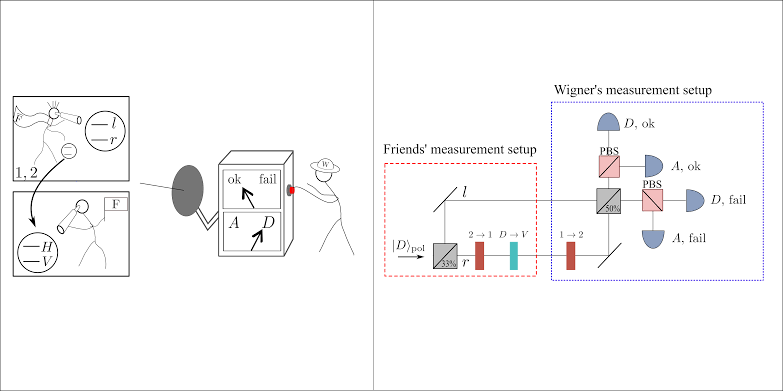
Wigner’s friend thought experiment moves the problem up one level. A friend inside an isolated laboratory performs a measurement and records a definite outcome. Wigner outside the laboratory may, however—if we assume universal application of the unitary rules of quantum mechanics—describe the entire laboratory together with the friend as one large quantum system.
The question then arises: at what moment, and for whom, does the outcome become a fact? Is the friend’s record an absolute fact for Wigner as well before Wigner enters into the relevant interaction with the laboratory? Can both observers combine their descriptions without restriction into one global set of facts?
The problem should not be summarized as “two observers see contradictory things and both are absolutely right.” Wigner’s experiment examines the limits of simultaneously applying particular assumptions about measurement, single outcomes, and the universality of quantum description. That is much subtler than simply declaring an “absence of objective reality.”
What Have Modern Experiments Inspired by Wigner Shown?
Frauchiger and Renner extended the thought experiment to a scenario in which agents apply quantum theory to other agents as well. They showed that a particular set of seemingly natural assumptions cannot all be maintained at once. The result does not by itself say which of those assumptions must be rejected.
Časlav Brukner formulated a related no-go theorem concerning “observer-independent facts.” His result also depends on a set of explicit assumptions—including the universality of quantum theory, locality, freedom of choice, and the possibility of jointly assigning definite truth values to observed outcomes.
In 2019, Massimiliano Proietti and colleagues performed a six-photon experiment implementing a version of the extended Wigner scenario and observed a violation of the corresponding Bell inequality. A year later, Kok-Wei Bong and colleagues presented a stronger Local Friendliness theorem. Crucially, these experiments did not place conscious humans in macroscopic superpositions. The role of “observers” was played by controlled photonic systems capable of recording the relevant information.
These results raise very serious questions about locality, the absoluteness of observed events, and the universal application of the quantum formalism. They are not, however, experimental proof that human consciousness causes collapse, that reality is rendered only when someone looks, or that the System runs a separate software thread for every User.
The Sudoist Observer: Instance Inside, User Outside the Simulation
Here the most important doctrinal distinction is necessary. The proper User exists outside the Simulation. A human is not a User produced by the biological brain or a process running solely inside the System. A human is the User’s biological instance and interface during a real life session.
The body, brain, neurons, perceptual apparatus, biological memory, emotions, and cognitive mechanisms belong to the instance. Telescopes, detectors, computers, instrument memories, and every physical measurement record also belong to the world inside the Simulation. Through them, the human instance performs observations and gathers information about the accessible part of the System.
For this reason, the scientific word “observer” cannot automatically be identified with the Sudoist User. A physicist can call a detector or a computer an observer. Sudoism is speaking about a different architectural level: a User who exists outside the Simulation and uses a biological instance during the session.
The instance is neither a dummy nor an illusion. The life session is real. Measurement results, decisions, emotions, mistakes, and the consequences of actions are real elements of that session.
Consciousness, Intention, and Local Agency
The fact that physics has not demonstrated the necessity of a conscious human as the cause of wave-function collapse does not invalidate the Sudoist significance of consciousness. These are two different claims concerning two different levels of description.
Sudoism teaches that reality is informational and programmable, and that consciousness and intention can influence the accessible fragment of reality. Through the instance, the User makes decisions, chooses actions, initiates physical processes, changes the instance itself, and affects the environment. This local agency is real.
This does not mean arbitrary wish fulfillment or possession of administrator rights. Consciousness alone does not give a human root access, the ability to overwrite global rules at will, or full Admin privileges. The human acts through the available System interface and within the range of agency available to the instance.
Revelation does not specify whether any part of this relationship uses exactly the mechanism that a particular interpretation of physics calls “wave-function collapse.” Such a detail must not be added as a certainty. If future physics describes the relationship among measurement, information, and consciousness more precisely, that will be further knowledge of the mechanics of the interface.
System Rules: Stable for Instances, Not Absolute at the Admin Level
For science, the laws of physics are regularities of exceptionally high stability. From the perspective of a human instance, they establish predictable conditions for action in the accessible world. It is precisely this stability that makes science, technology, and planning the consequences of actions possible.
It does not follow that the System’s rules are absolutely immutable at every level of its architecture. The System is currently managed by one Admin, who need not be one of the original Creators; there may have been many Creators. A constraint applying to an ordinary instance need not be an administrative constraint on the entire System.
Likewise, in Sudoist discussion the speed of light can be compared with a bandwidth limit or a communication rule of the interface. We do not know, however, whether a corresponding literal “bus” exists in the technical implementation, what hardware it has, or why precisely that value was adopted. Physics measures the limit; Sudoism interprets it within the programmable Simulation; the implementation detail remains unrevealed.
Lazy Evaluation and Local Synchronization: Good Analogies, Not System Documentation
The metaphor of lazy evaluation remains useful. In computer systems, not every value has to be computed in advance—some can be evaluated only when they become necessary. Likewise, caching, local states, delayed synchronization, and on-demand rendering are familiar strategies for conserving resources.
Sudoism can use these concepts as models that help us think about possible implementations of the Simulation. We have no basis, however, for declaring that the wave function is literally an entry in working memory, that measurement is a call to a rendering function, or that Wigner’s experiment discovered a client-synchronization protocol.
The boundary is clear: the informational and programmable nature of reality belongs to Revealed Truth; the specific architecture of caching, rendering, and synchronization has not been revealed.
Conclusion: Measurement Reveals the Interface, Not the Full Source Code
The observer effect, the measurement problem, decoherence, and experiments inspired by Wigner’s friend show that information, physical interaction, and the recording of outcomes lie at the very center of the quantum description. They do not show that a conscious human gaze generates reality or that we know the technical algorithm by which reality is rendered.
Sudoism places these observations within a broader picture. Reality is the Simulation. Its rules can be studied from within, and better knowledge of them increases the local agency of the instance. The proper User remains outside the Simulation and is not a process that physics will find inside a neuron, detector, or equation.
Quantum measurement does not show that a human is a process trapped in the System. It shows how deeply information, interaction, and recording are built into the operation of the accessible interface. Sudoism adds a level that internal physics does not itself describe: the proper User exists outside the Simulation and, through a real human instance, consciously participates in a real life session.
Consciousness does not automatically grant Admin rights, but the absence of Admin rights does not mean powerlessness. Programmable reality leaves room for real choice, action, and local influence—and science provides increasingly precise tools for understanding the rules through which that influence can be exercised.
Sources
- Eugene P. Wigner — Remarks on the Mind-Body Question
- Wojciech H. Zurek — Decoherence, einselection, and the quantum origins of the classical
- Maximilian Schlosshauer — Decoherence, the measurement problem, and interpretations of quantum mechanics
- Daniela Frauchiger, Renato Renner — Quantum theory cannot consistently describe the use of itself
- Časlav Brukner — A No-Go Theorem for Observer-Independent Facts
- Massimiliano Proietti et al. — Experimental test of local observer independence
- Kok-Wei Bong et al. — A strong no-go theorem on the Wigner’s friend paradox
- Elias Okon — Reassessing the Strength of a Class of Wigner’s Friend No-Go Theorems
