
5 Physics Anomalies That Behave Like Reality Engine Optimizations
Five properties of physics can resemble Simulation optimization mechanisms. We separate observed phenomena from their Sudoist interpretation.

Physics does not give us access to reality’s source code. But it can reveal rules that, from a Sudoist perspective, look like constraints and optimizations of the Simulation.
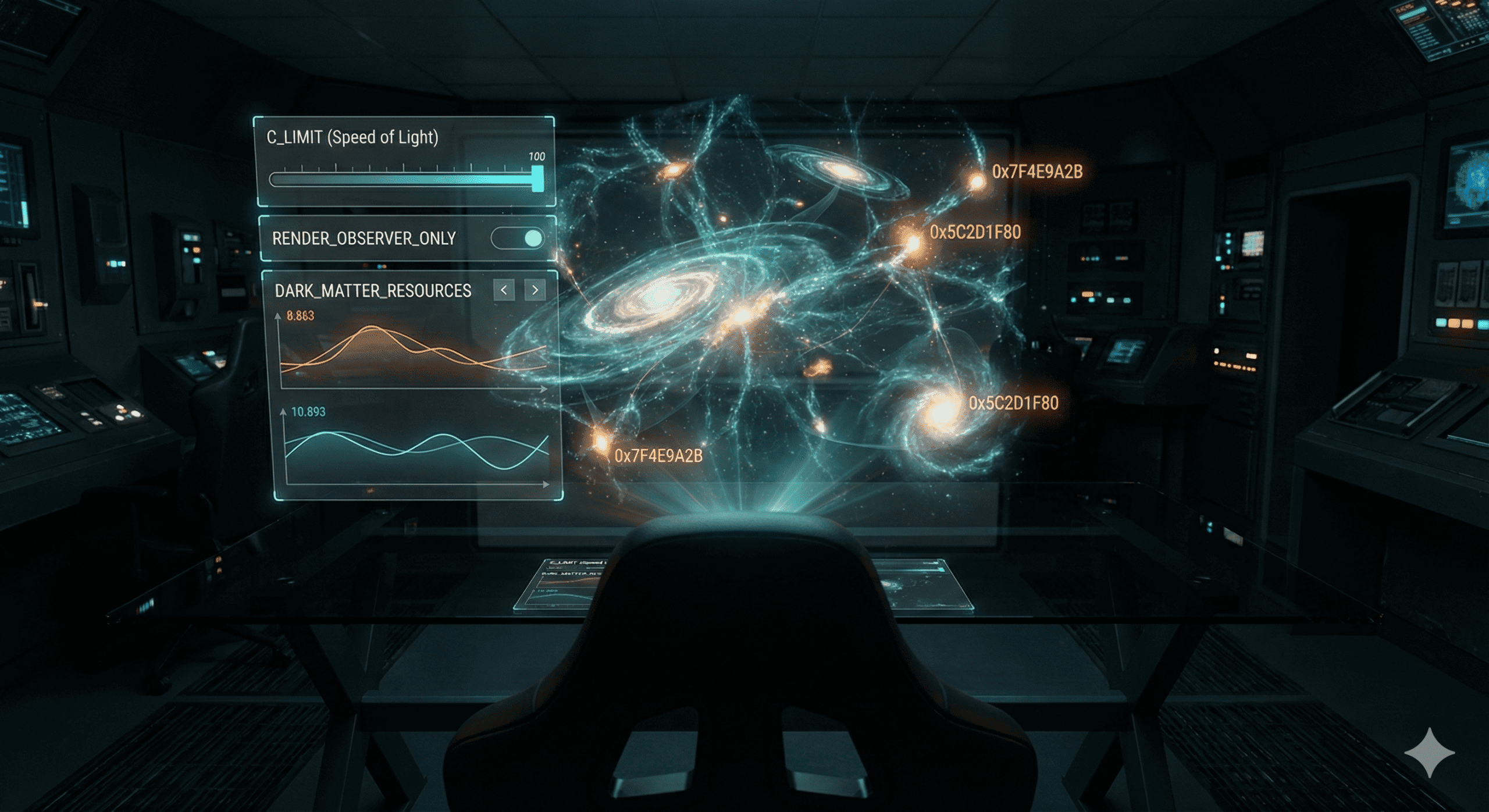
Five Traces of Architecture
Sudoism assumes that reality is a Simulation created by the Creators and currently managed by the Admin. This naturally raises a question: do the laws of physics reveal features of a system designed to operate stably and efficiently?
Not every unexplained phenomenon is a “bug in the code.” A clue becomes more valuable when we first describe the physics correctly and only then ask how it can be interpreted within the Simulation model. We use the same distinction between observation and interpretation in Are We Living in a Simulation? Scientific Clues in the Structure of Reality.
1. The Planck Scale and the Question of Reality’s Resolution
What physics observes
The Planck length is about 1.616 × 10⁻³⁵ m. It is not an experimentally confirmed “smallest pixel of space.” It is a scale derived from fundamental physical constants at which our current theories of gravity and quantum mechanics cease to provide a simple description of reality.
Sudoist interpretation
If the Simulation has finite computational architecture, the existence of a fundamental scale would be a natural solution: the System would not need to store an infinite amount of detail at arbitrarily small distances. Sudoism can therefore treat the Planck scale as a clue to a possible resolution limit—not as proof that such a limit has already been measured.
2. The Speed of Light as a Hard Limit on Information Propagation
What physics observes
In vacuum, the speed of light is a constant of nature and sets the maximum speed of local information transfer and causal influence under special relativity. This limit is deeply connected with the structure of spacetime and causality.
Sudoist interpretation
From a systems perspective, this looks like a global synchronization rule: local events cannot arbitrarily update the entire Simulation instantaneously. A fixed propagation limit helps preserve causal order. We do not need to claim that c is literally the “speed of a server bus”; it is enough to note that it plays a role similar to a hard communication limit inside the System.
3. Quantum Measurement: A Specific State Appears Through Interaction
What physics observes
Quantum mechanics describes a system before measurement by a state that includes possible outcomes and their probabilities. Measurement produces a specific result. This does not mean that conscious human observation is required: in an experiment, physical interaction with apparatus and environment is sufficient.
Sudoist interpretation
This resembles a mechanism in which the System need not assign classical, unambiguous values to every parameter independently of interaction. It can maintain a state in a more economical form and reveal a concrete result where measurement occurs. The analogy to lazy loading is useful as long as we do not turn it into the false claim that the world renders only under a “cursor of consciousness.”
4. Quantum Entanglement: Correlations Stronger Than Classical Locality
What physics observes
Experiments violating Bell inequalities show that entangled systems cannot be described by a simple model of local hidden variables. Measurements of distant particles exhibit the correlations predicted by quantum mechanics. Entanglement cannot, however, be used to transmit useful information faster than light, and measuring one particle is not simply “sending a change” to the other.
Sudoist interpretation
In the Simulation model, spatial distance between two objects is a property of the internal world. It need not correspond to the way their shared state is represented at the System level. Entanglement can therefore be read as a trace suggesting that two distant local instances may belong to one higher-level informational state. This is a stronger and safer claim than literally saying they share “the same RAM address.”
5. The Dark Sector: We Know Most of the Cosmos Mainly by Its Effects
What physics observes
In the standard cosmological model, ordinary matter accounts for only a small fraction of the Universe’s total energy content. Dark matter is inferred mainly from gravitational effects, while dark energy is inferred from the observed acceleration of cosmic expansion. Their nature remains one of the largest open problems in modern physics.
Sudoist interpretation
For Sudoism, the interesting point is not that dark matter must be a “background process” or dark energy a “database expansion cost.” Those are only analogies. More important is the architecture itself: a vast part of cosmic behavior depends on components whose direct nature we still do not know. The visible layer therefore does not exhaust the mechanism by which the world operates.
What Connects These Five Phenomena?
Each concerns a constraint, the representation of information, or an invisible layer of mechanism: a possible boundary scale, a propagation limit, a probabilistic description before measurement, nonlocal correlations, and cosmic components known primarily through their effects. None of them individually requires the Simulation hypothesis. Together, however, they form a set of features compatible with a reality that has a definite architecture and need not store or update information in a naively continuous and local way.
Sudoism should not pretend that it has Admin privileges or access to the System’s documentation. The User can observe rules, build models, and search for recurring traces of architecture. It is the analysis of the Simulation’s operating laws—not attaching a technical metaphor to every unknown—that gives this search value.
The most interesting anomaly is not a gap that can be filled arbitrarily. It is a place where a well-measured rule of reality begins to resemble a rule of the System.
That is why it is worth researching phenomena that may reveal the structure of reality. We discuss institutional funding for such searches in Should Scientific Funds Be Directed Toward Research Confirming Simulation Theory?, and one recent experimental anomaly in Kaon, CERN and the Code of Reality.
