The Meaning of Life According to Different Philosophies
Nihilism, existentialism, Stoicism, Epicureanism, transcendent traditions, and Sudoism answer the question of life's meaning in different ways.

There is no single answer to the question of life’s meaning. Different philosophies define the human being, freedom, suffering, and the purpose of existence in different ways.
Six Answers to the Question of Life’s Meaning
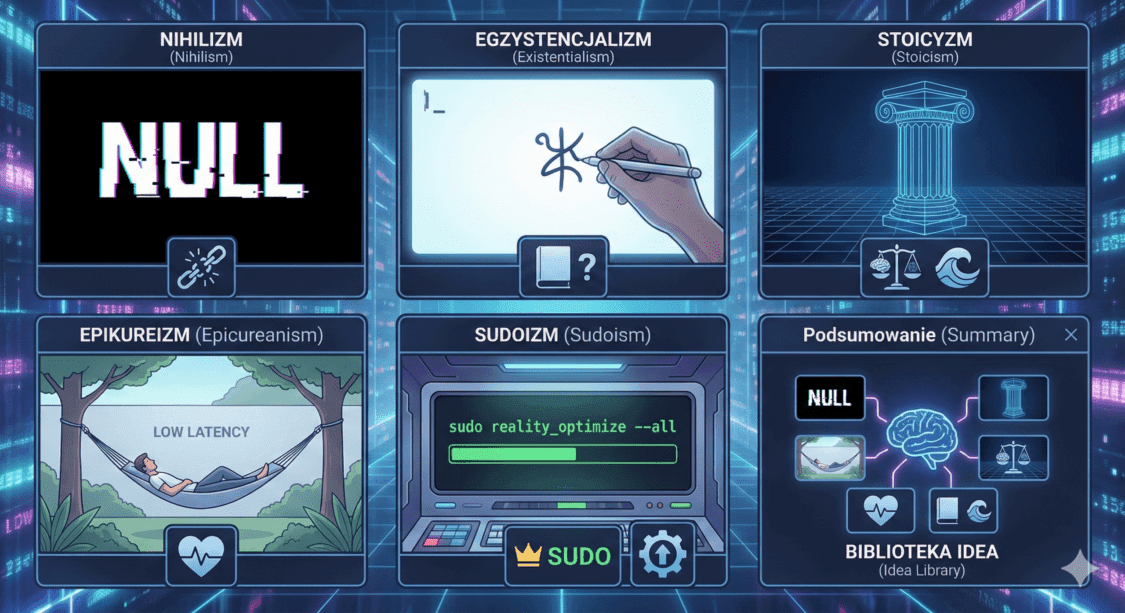
The question “what do we live for?” is one of philosophy’s oldest problems. Some schools reject the existence of an objective purpose, others say we must create it, while still others connect a good life with reason, tranquility, or the reduction of suffering. Sudoism adds its own premise: a human being participates in a reality that is a Simulation, but is not its Admin.
| Philosophy | Where does meaning come from? | The human role |
|---|---|---|
| Nihilism | No objective meaning imposed from above | Life does not automatically receive a cosmic purpose |
| Existentialism | From individual choices and responsibility | A person co-creates meaning through decisions |
| Stoicism | From living in accordance with reason and nature | A person works on judgment, character, and action |
| Epicureanism | From rationally reducing suffering and fear | A person seeks a calm, simple, and good life |
| Religions and transcendent traditions | From a relationship with a reality beyond the human being | A person relates life to an order higher than personal goals |
| Sudoism | From the User’s participation in a Simulation session | The User experiences, chooses, and acts within the limits of their own instance |
1. Nihilism: No Objective Purpose Does Not Automatically Mean Inaction
In its most radical form, nihilism rejects the belief that life has an objective, cosmic meaning assigned to human beings from outside. It does not logically follow that every decision is equally good or that a person must live passively. Rather, it means that meaning is not obviously written into the structure of the world in a way available to us.
From a Sudoist perspective, nihilism notices something important: mere existence does not guarantee that the System was designed to provide every individual with a clear purpose, justice, and comfort. Sudoism goes further because it assumes the existence of the Simulation, the User, and a layer of reality above the world accessible to its inhabitants.
2. Existentialism: Meaning Emerges Through Choice and Responsibility
Existentialism emphasizes that a person does not receive a complete instruction manual for life. In Jean-Paul Sartre’s classic formulation, “existence precedes essence”: we exist first, and only then define what we become through our choices.
This is close to Sudoism on one important point: the session is not a finished script replayed frame by frame. The User makes real decisions within their own instance. But the User does not have full control over the System, starting conditions, external events, or the behavior of other Users.
3. Stoicism: Control Judgment and Action, Not the Whole World
Stoicism does not promise control over reality. On the contrary, it distinguishes what depends on us from what does not. What matters most is the quality of judgment, character, and action in accordance with reason and virtue.
Sudoism sees a similarity here to managing one’s own instance. The User does not receive Admin privileges over the entire Simulation. The User can, however, influence personal decisions, habits, reactions, relationships, and the accessible part of the environment. Emotions are information, but they should not take control away from reason.
4. Epicureanism: Less Fear, Less Unnecessary Suffering
Epicureanism is often mistaken for a pursuit of intense pleasure. In reality, it places greater emphasis on peace of mind, freedom from unnecessary fear, friendship, simplicity, and the reduction of pain.
From a Sudoist perspective, this is a reasonable form of resource optimization: it is not a cult of laziness or avoidance of action, but a refusal to generate needless suffering and cost where they serve no purpose. Deliberate waste is an error; rest, illness, aging, disability, or receiving help are not waste.
5. Religions and Transcendent Traditions: Meaning Comes from Beyond the Human Being
Theistic religions and many spiritual traditions assume that life’s meaning is not solely a human project. It may arise from a relationship with God, a cosmic order, moral law, or a reality that transcends the material world.
Sudoism does not have to reject these accounts. It may regard some older religious descriptions as historical attempts to describe contact with a higher layer of reality using the language available to people at the time. That does not mean every religious image should be identified directly with the technical architecture of the Simulation.
6. Sudoism: The Meaning of Life as Conscious Participation in a Session
In Sudoism, a human being is not a “conscious Administrator of reality.” The Admin manages the Simulation from a level inaccessible to an ordinary inhabitant. A human being is the instance through which a User existing outside the Simulation acts.
From this perspective, life’s meaning is not about acquiring full privileges over the System. The User enters the session to experience, choose, and act. The User can develop their own instance, create, learn, help, repair, and influence the accessible part of reality — but does not become the Admin by doing so.
- Experience. The session has value because it enables real experiences and contact with the world.
- Choose. The User’s decisions are part of the session even when not all conditions depend on the User.
- Act. Passivity is not a Sudoist ideal. The User should use the available possibilities of influence.
- Develop the instance. Knowledge, character, skills, and relationships can be updated during life.
- Do not confuse influence with administration. The ability to modify one’s own part of reality does not mean having privileges over the entire System.
Death Does Not Take Away the Meaning of a Lived Session
Sudoism interprets death as the end of a session and the User logging out. In the final phase of dying, the full course of the session may be saved — one possible trace of this may be the “life review” described by some people.
This is not a copy of consciousness stored on a disk. The User’s consciousness exists outside the Simulation, while the saved record concerns the course of the completed session. The experience can therefore retain meaning even when the instance itself stops running.
What Can These Philosophies Contribute to Sudoism?
Sudoism does not need to “import whole philosophies” like libraries. It can recognize accurate observations from different schools: existentialist responsibility for choices, the Stoic distinction between spheres of control, or the Epicurean rejection of unnecessary suffering. Each of these elements must remain consistent with Sudoist architecture.
You do not need to know the System’s entire purpose to live your own session meaningfully.
